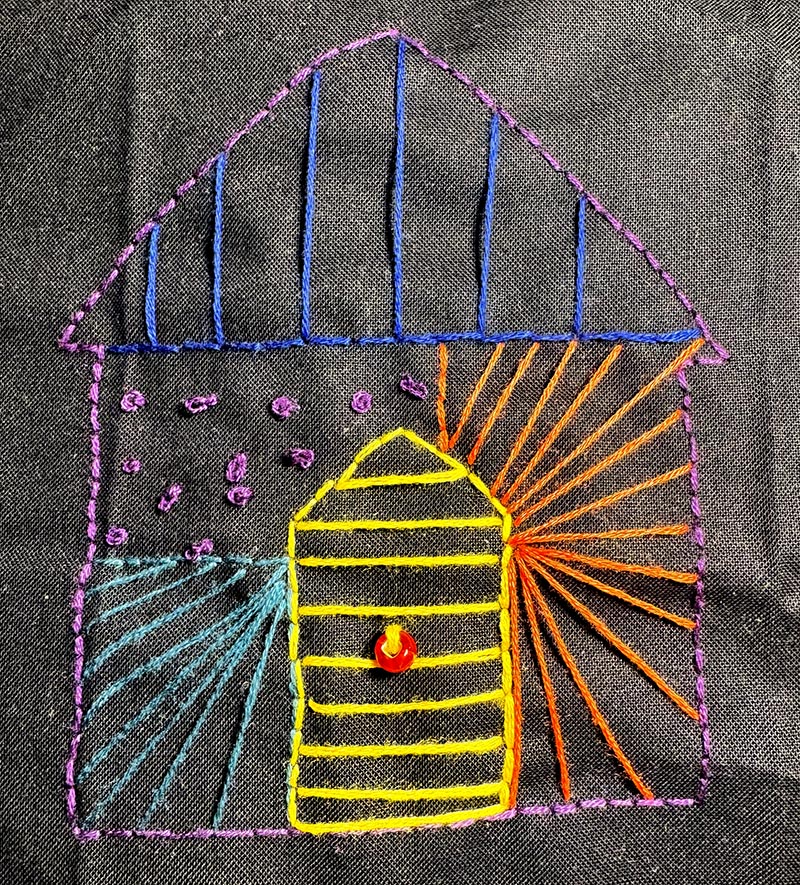
 For her final project for Data Visualization with Textiles 2025, Symantha Hom did an embroidery using Civic Data, using the properties of color, organization, and stitch.
For my final textile project, I created a stitched house to represent national foster care outcomes in the United States, using data from the Adoption and Foster Care Analysis and Reporting System (AFCARS, 2023). This dataset outlines the paths children take after leaving foster care. Whether they are reunified with their families, adopted, placed in guardianship, age out of the system, or exit through less defined channels. Rather than translating this data into a chart or graph, I chose a house as the central image for the piece–a universal symbol of safety, and belonging. For many children in foster care, a stable home remains out of reach, and I wanted to explore this tension visually. My goal was to create a piece that reflects not just the numbers, but the emotional weight behind them.
Rather than using charts or graphs, I chose to center the project around a stitched house, which is a symbol of safety and belonging. The shape of the house became a visual stand-in for “home,” and I used color, placement, and stitch technique to reflect how differently that idea plays out for children in foster care. The house is proportionally divided to match five national outcome categories from the data. The roof area is blue, stitched broadly to represent the 44% of children who are reunified with their families. I placed this section at the top because reunification is often viewed as the most ideal or intended outcome. Its placement as the roof felt natural, providing shelter and closure. The door is stitched in yellow, representing the 27% of children adopted into new families. It serves as a symbolic entry point– a new threshold, a new beginning. I placed a small bead within the door to mark myself in the data. As someone who was adopted, this addition makes the piece deeply personal. It was important to me not just to visualize the system from the outside, but to acknowledge my own place within it.
To the right of the house, the green section represents the 9% of children who age out of foster care. These youth exit the system without permanent placement or consistent adult support. The green color, rather than representing growth or calm, here feels slightly dislocated, off to the side, unresolved, and not fully enclosed by the structure of the house. The left portion is stitched in orange, representing the 10% of children placed in guardianship. I chose a clean, simple texture to reflect the idea that this outcome offers some stability, but is distinct from adoption or reunification in legal terms. Finally, the purple section made up of French knots represents the 10% of children whose outcomes are categorized as “Other.” These include children who run away, are transferred to other systems, or whose status is unknown. I intentionally used French knots here to create texture and tension. This section feels scattered, hard to read, just like the lives it represents.
The hardest part of this project was not the stitching itself, but deciding how to represent each outcome in a way that felt both visually balanced and emotionally honest. I didn’t want the piece to feel clinical or cold, but I also didn’t want it to be overly sentimental. I’m proud of how each section stands on its own while still coming together to form a single, unified structure. If I could change anything, I might have built in more room for stitched text or numbers, but in the end I think the piece is more powerful without over-explaining. It invites viewers to look closely and explore what the visualization could mean to them.
This project helped me connect more personally to the data than I expected. The stitch that represents me felt incredibly grounding. Every number in the dataset is a life. Every stitch is someone’s story.